
Blog
If you’ve started to research LASIK, within a few clicks, you’ve likely run into terms like Contoura, custom, and topography-guided, usually with no explanation attached about what these words really mean.
It is hard to know whether these are real differences in how the surgery works or just marketing labels stacked on the same procedure. Topography-guided LASIK is a genuine technological step, and the way it plans a correction is different from older approaches.
Keep reading to learn what topography-guided LASIK actually is, how the corneal mapping behind it works, what happens during the procedure, and how to tell whether it might fit your eyes.
What Exactly Is Topography-Guided LASIK?
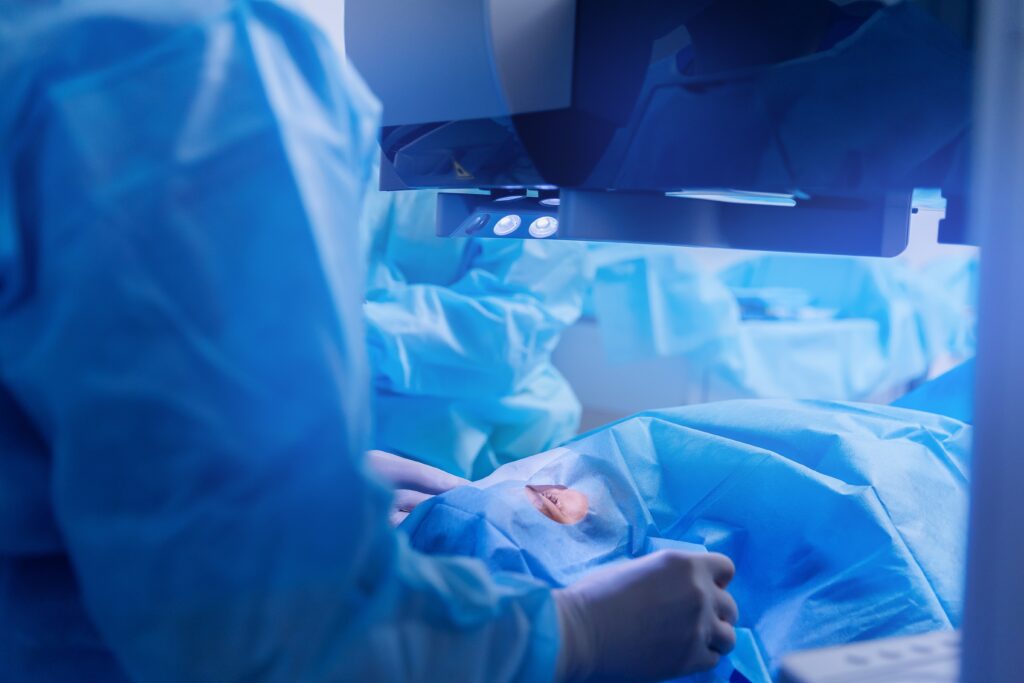
Topography-guided LASIK is a form of laser vision correction that builds your treatment from a detailed map of your cornea’s actual surface, not from your eyeglass prescription alone.
Your cornea is the clear, dome-shaped front surface of your eye, and it does most of the focusing work that lets you see. When its shape is slightly off, light lands in front of or behind the retina instead of right on it, which is what makes vision blurry.
Standard LASIK and topography-guided LASIK both correct that problem by reshaping the cornea with a laser, but they start from different information.
A traditional correction is based largely on the same numbers that go into your glasses. Two people with an identical prescription can have corneas shaped quite differently, yet a prescription-based plan would treat them almost the same way. Topography-guided LASIK closes that gap by measuring the unique contours of your eye first, then designing the correction around what the map shows.
How Does Corneal Mapping Create Your Treatment Plan?
The mapping step is where this approach earns its name. At LASIK Vision Centers of Cleveland, the Contoura Vision system uses a WaveLight TOPOLYZER Vario device to scan the surface of your cornea in fine detail. It records up to 22,000 elevation points across a surface that measures only about 12 millimeters from edge to edge. That surface is smaller than a dime, less than half an inch across, so fitting 22,000 measurements onto it means the scan picks up detail far finer than your prescription could describe. Each point tells the laser the exact height of your cornea at that tiny spot, the way a topographic map charts the rise and fall of land.
Another way to picture it is instead of treating your cornea as a smooth, even dome, the advanced corneal mapping technology reads it as a landscape with its own peaks, ridges, dips, and valleys. Every eye has small irregularities, and no two maps look the same. Once the scan is complete, that data programs the laser so it knows exactly where your cornea sits high, where it sits low, and how much tissue to adjust at each point.
The treatment is shaped to your specific surface, which is part of why the practice describes a Contoura correction as being as individual to you as a fingerprint.
What Happens During the Procedure?
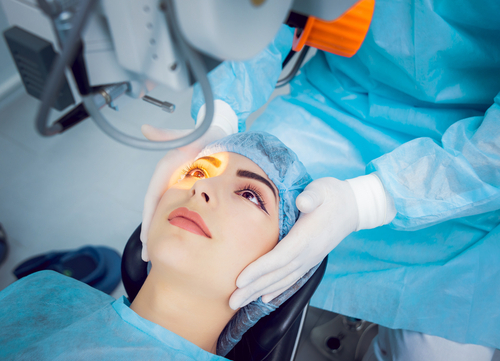
The mapping is done before surgery, during your consultation and pre-operative workup, so the plan is ready before you ever lie down for the procedure itself. The surgery has a clear sequence, and knowing the steps involved on the day of LASIK tends to take the mystery out of it.
First, numbing drops go in, so you stay awake but comfortable and feel no pain. A femtosecond laser then creates a thin, hinged flap in the surface of the cornea. This is the bladeless part of modern LASIK, where rapid pulses of laser light form the flap without any mechanical cutting tool. The surgeon gently folds the flap back to expose the tissue underneath.
Next comes the reshaping. The excimer laser delivers its pulses according to your topography map, placing each one where the data calls for it rather than applying a uniform pattern. You focus on a small fixation light while this happens, and the laser tracks your eye throughout. The active treatment usually lasts well under a minute per eye. When it finishes, the surgeon repositions the flap, which begins to seal on its own without stitches. Most patients are surprised by how quickly the whole appointment is over.
Who Qualifies for Topography-Guided LASIK?
Roughly 40 percent of patients at the practice qualify for Contoura, with the rest typically directed toward wavefront-optimized treatment or another option that suits them better.
The only way to know your category is a full evaluation. LASIK Vision Centers of Cleveland sets the regional standard for matching each patient to the right procedure, checking whether you are a candidate against detailed criteria before recommending anything.
That evaluation looks at the thickness and shape of your cornea, the stability of your prescription, your age, and the overall health of your eyes, including whether you have significant dry eye.
Bringing your questions to the consultation helps. If topography-guided LASIK is not right for you, the consultation will point you toward the option that is.
What Can Custom, Map-Guided Vision Look Like?

The goal of mapping your cornea is not only to help you reach 20/20 on a chart. It is to improve the quality of what you see. Because the laser addresses the small irregularities unique to your eye, many patients notice sharper detail and cleaner vision in low light, with less glare and fewer halos around headlights or streetlights at night. Those are exactly the quality-of-vision improvements that a prescription-only correction can leave on the table.
For people who spend evenings driving, working on screens, or playing sports, that difference in visual quality often matters as much as the number on the eye chart. Whether topography-guided LASIK turns out to be your best option or simply one of several worth comparing, the decision starts with seeing your own corneal map and learning what it reveals.
Ready to find out whether topography-guided LASIK is right for your eyes? Schedule an appointment at LASIK Vision Centers of Cleveland in Cleveland, OH.