
Blog
Before anyone talks to you about scheduling surgery, you spend a couple of hours having your eyes measured in ways not covered during most routine exams. The LASIK consultation contains thorough testing, and every test has a purpose. Knowing what each one checks, and why it matters, takes the mystery out of the visit and helps you understand the results you walk away with.
Here is what to expect when you sit down for a LASIK evaluation in Cleveland.
What is a LASIK Consultation?

A LASIK consultation is a screening process designed to answer one very important question with confidence: are your eyes a good match for laser vision correction, and if so, which approach fits them best?
The experienced surgeons at LASIK Vision Centers of Cleveland evaluate each patient against a detailed set of measurements before recommending the procedure, which means no two treatment plans start from the same assumptions.
Your appointment usually runs longer than a standard eye exam. Plan for a bit of downtime afterward too, since some of the tests involve dilating your eyes. If you wear contact lenses, you will be asked to stop wearing them for a period before the visit, often several days for soft lenses and longer for rigid ones. Contacts temporarily change the shape of your cornea, and accurate measurements depend on your eyes returning to their natural form.
What Happens During a LASIK Consultation?
When you visit your eye doctor for a LASIK consultation, you can expect to experience the following tests and procedures:
Vision and Prescription Testing
The visit starts with the tests that feel familiar. A visual acuity test measures how clearly you see at various distances using an eye chart. This establishes your starting point and shows how much correction your eyes currently need.
Next comes refraction, the part where you look through different lenses and report which ones sharpen the image. Refraction pins down your exact prescription, including any nearsightedness, farsightedness, or astigmatism that LASIK might correct.
A key factor here is prescription stability. If your numbers have shifted noticeably in the past year, that instability can affect whether LASIK makes sense right now, and your surgeon will want to understand the trend before moving forward.
Mapping and Measuring Your Cornea
Your cornea, the clear dome at the front of your eye, is where the laser corrects your vision during LASIK. Because of that, several tests focus entirely on its shape and thickness.
Corneal Topography
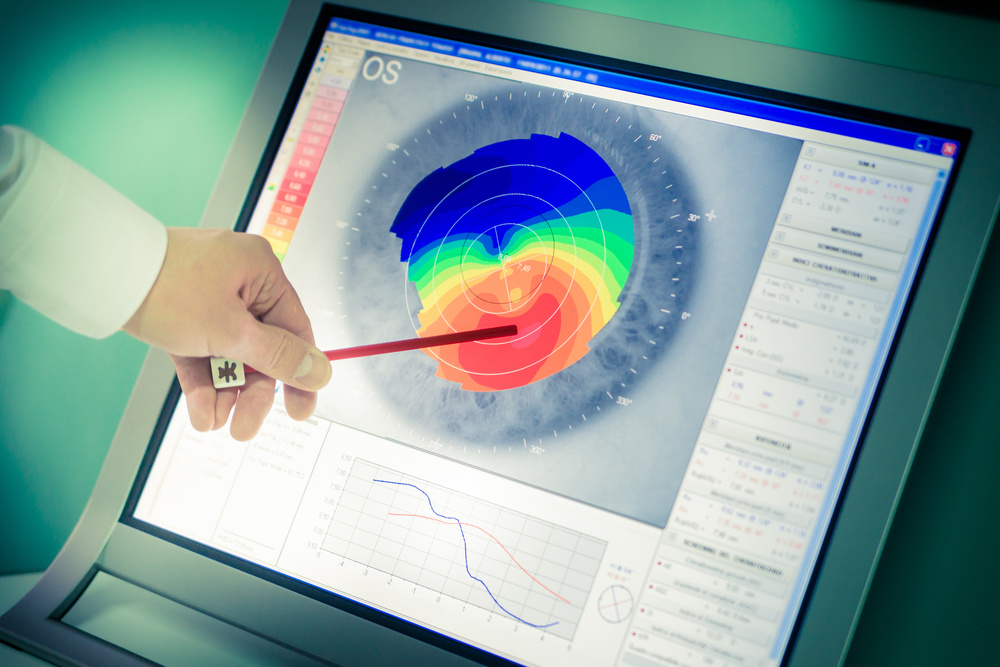
Corneal topography creates a detailed map of the curvature across the surface of your eye. This map reveals irregularities that a standard exam would miss, including early signs of conditions like keratoconus that could rule out LASIK. The technology used to map and treat the eye has become precise enough to catch subtle patterns that matter a great deal for a safe outcome.
Corneal Thickness
A measurement called pachymetry checks how thick your cornea is. LASIK works by reshaping corneal tissue, so there needs to be enough thickness to work with while leaving a healthy, stable layer behind. Thin corneas are one of the more common reasons a patient turns out not to be a candidate for traditional LASIK, though other options may still be on the table.
Checking Pupil Size and Your Tear Film
Two smaller tests carry more weight than their size suggests.
Your pupils are measured in dim lighting to see how wide they open in the dark. Pupil size influences how your surgeon plans the treatment zone, and it factors into conversations about night vision after surgery.
Your tear film also gets evaluated. Dry eye is common, and LASIK can make existing dryness more noticeable in the weeks after surgery. Identifying it beforehand lets the team address it early, which improves both your comfort and your healing. If dryness turns out to be significant, treating it first is part of a responsible plan rather than an obstacle.
The Full Eye Health Exam
Beyond the LASIK-specific measurements, the consultation includes a thorough look at the overall health of your eyes. Your surgeon checks the pressure inside each eye, examines the retina and optic nerve, and often dilates your pupils to see the internal structures clearly. Dilation is why you may want someone to drive you home, since bright light and close-up focus can be difficult for a few hours afterward. Your eye doctor will also ask about your medical history since certain conditions, medications, and even pregnancy can affect timing or candidacy. This is the point in the visit to mention anything relevant, because a complete picture leads to a safer recommendation.
What Happens After Your Test Results Come In

Once every measurement is collected, your surgeon reviews the full set together rather than judging any single result in isolation. All of the data feeds into a candidacy decision, and the practice weighs each patient against the specific criteria that predict a successful outcome.
If traditional LASIK is not the right fit, the conversation does not end there. Patients with thinner corneas may be better suited to PRK, a surface-based laser procedure that treats vision without creating a corneal flap.
The goal of the consultation is to match your eyes to the approach most likely to give you the vision you want, even when that means recommending something other than standard LASIK.
By the end of the visit, you should understand your measurements, your options, and the reasoning behind the recommendation you receive. That clarity is the whole point of testing so thoroughly before anyone picks up a laser.
Ready to find out if your eyes are a good match for laser vision correction? Schedule an appointment at LASIK Vision Centers of Cleveland in Cleveland, OH.